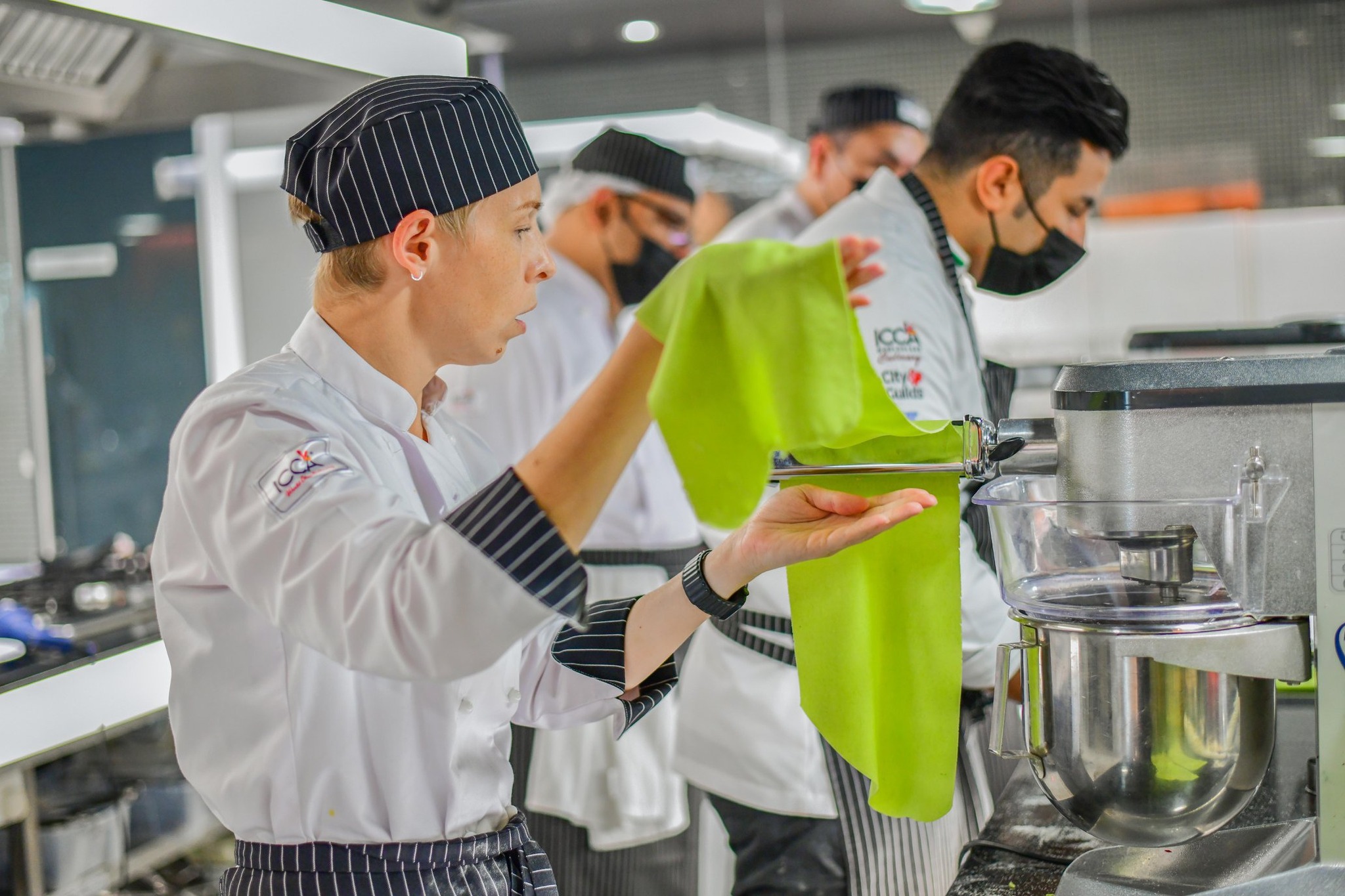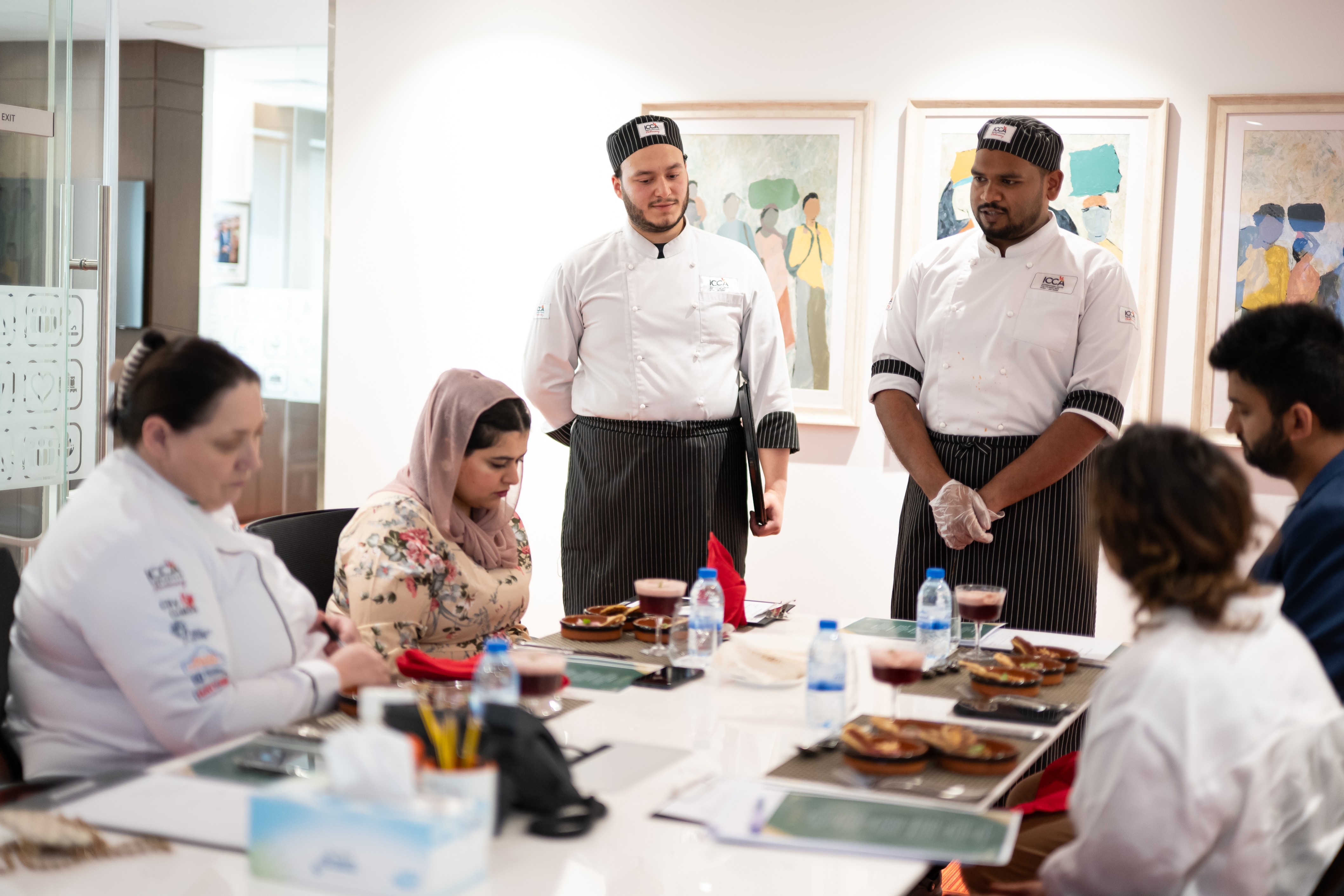
Corporate training in Dubai has moved from being a staff benefit to becoming a practical business requirement. In a city shaped by hospitality, finance, aviation, logistics, real estate, technology, healthcare, and international trade, companies need teams that can work across cultures, communicate clearly, adapt quickly, and deliver consistently. Dubai’s business environment also places growing emphasis on capability building. The Dubai Economic Agenda D33 aims to double the size of Dubai’s economy by 2033 and position the city among the world’s top three cities for living, investing, and working. For employers, this means workforce development is directly linked to competitiveness, service quality, retention, and operational performance. For HR managers, L&D professionals, business owners, and department heads, choosing the right corporate training in Dubai is not simply about finding a course provider. It is about identifying a training partner that understands your industry, your people, your operating environment, and the outcomes you expect after the program is completed.
Why Corporate Training Matters in Dubai’s Business Landscape
Dubai’s workforce is one of the most multicultural in the world. Teams often include professionals from different nationalities, industries, education systems, and communication styles. This gives companies access to broad talent, but it also makes structured training more important.
Corporate training helps companies create a shared working language. It can improve leadership habits, guest handling, sales conversations, internal communication, service standards, technical capability, and team coordination. In sectors such as hospitality, aviation, healthcare, logistics, and finance, training also supports consistency, compliance, and customer confidence.
The UAE’s focus on Emiratisation and private-sector talent development adds another layer of importance. Nafis, the UAE’s federal program for Emirati talent competitiveness, supports training and employment pathways for UAE nationals in the private sector. This makes workforce planning, onboarding, and upskilling increasingly relevant for companies operating in the UAE.
Corporate training should therefore be treated as a business investment, not a one-off HR activity. A hotel may use training to improve guest satisfaction. A restaurant group may need stronger kitchen consistency and menu control. A logistics company may require safer procedures. A sales team may need better negotiation discipline. A growing SME may need middle managers who can lead people, not only supervise tasks.
For companies comparing wider learning options, ICCA’s guide to best courses in Dubai also gives useful context on how skills-based education is developing across the city.
Types of Corporate Training Available in Dubai
Corporate training in Dubai covers a wide range of business needs. The most suitable format depends on the company’s sector, team size, current capability gaps, and expected business outcome.
Leadership & Management Development
Leadership and management training is one of the most common forms of corporate training in Dubai. It is especially relevant for companies that are expanding, restructuring, entering new markets, or preparing high-potential employees for larger roles.
Typical programs may cover executive coaching, C-suite development, middle management skills, delegation, performance management, strategic leadership, succession planning, and decision-making under pressure.
In Dubai, leadership training also needs to reflect multicultural team realities. Managers are often responsible for employees with different languages, work expectations, communication habits, and levels of experience. Strong leadership training should therefore move beyond theory and help managers handle real workplace situations with clarity and confidence.
Technical Skills Training: IT, Data & AI
Technical training is growing quickly as companies adopt new systems, automation tools, AI platforms, cybersecurity practices, and data-led decision-making. The UAE National Strategy for Artificial Intelligence 2031 places clear emphasis on AI talent, upskilling, and future-readiness.
Common technical training areas include cloud computing, data analytics, cybersecurity awareness, AI fundamentals, digital transformation, business intelligence, CRM systems, automation tools, and software-specific training.
The duration can vary widely. Some sessions are short awareness workshops, while others are exam-preparation courses, certification pathways, bootcamps, or internal transformation programs. Companies should therefore check the actual learning outcome before comparing fees or schedules.
Soft Skills & Communication
Soft skills training is especially important in Dubai because business is highly international. Communication gaps can affect sales, service, guest relations, internal trust, leadership, and customer retention.
Popular areas include presentation skills, negotiation, emotional intelligence, conflict resolution, customer service, cross-cultural communication, business English, Arabic communication basics, and client relationship management.
For customer-facing companies, soft skills are not secondary. A well-trained team can manage complaints better, handle pressure more calmly, and protect the brand experience during difficult service moments.
Industry-Specific Training: Hospitality, Finance, Healthcare & More
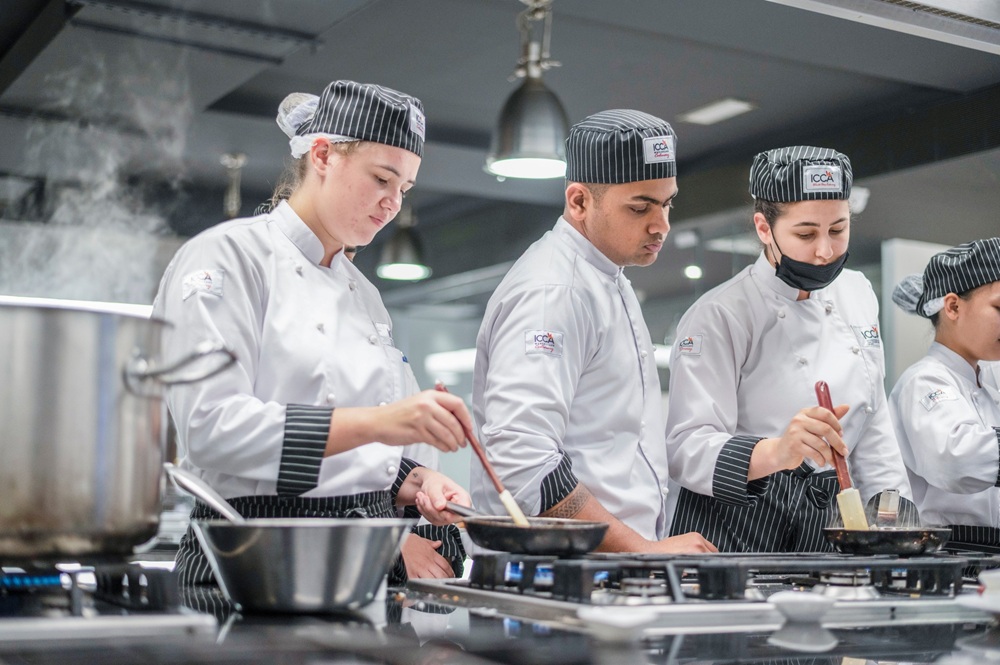
Industry-specific corporate training in Dubai is often the most commercially useful because it connects directly to daily operations.
Hospitality companies may need training in culinary operations, F&B service, guest experience, food safety, menu planning, kitchen coordination, and team supervision. Finance companies may require training linked to regulation, compliance, risk, internal controls, and client advisory standards. Healthcare providers may need patient communication, quality, safety, and compliance-focused development. Real estate, aviation, construction, logistics, and retail also have their own training needs.
For hospitality and F&B businesses, the most effective learning usually happens close to the real working environment. Skills such as kitchen timing, recipe consistency, menu costing, and service recovery cannot be fully understood through classroom discussion alone.
Team Building & Experiential Learning
Team building has become a serious part of corporate training in Dubai. Companies increasingly want programs that build practical behaviours, not only provide a social activity.
Experiential learning can include culinary team building, outdoor challenges, escape rooms, simulation exercises, corporate retreats, and collaborative workshops. The strongest formats are designed around clear outcomes: communication, leadership, trust, problem-solving, time management, and shared accountability.
Culinary team building is particularly effective because a professional kitchen naturally creates pressure, structure, timing, coordination, and creativity. It allows team behaviours to become visible in a practical and memorable way.
ICCA Dubai’s Corporate Training Solutions
ICCA Dubai brings a specialised hospitality and culinary perspective to corporate training in Dubai. As a professional culinary training institution based in the UAE, ICCA’s strength lies in hands-on learning, real kitchen environments, industry-connected training, and practical skills development.
For corporate clients, ICCA is especially relevant when the objective is not only to conduct a workshop, but to create an engaging learning experience that reflects communication, coordination, leadership, timing, creativity, and operational discipline.
Unlike a casual cooking class, ICCA’s corporate experiences are delivered in a professional culinary training environment. Participants work together, manage tasks, prepare food, solve problems, and complete the experience as a team. This makes the learning practical, active, and easy to connect back to the workplace.
Corporate Team Building
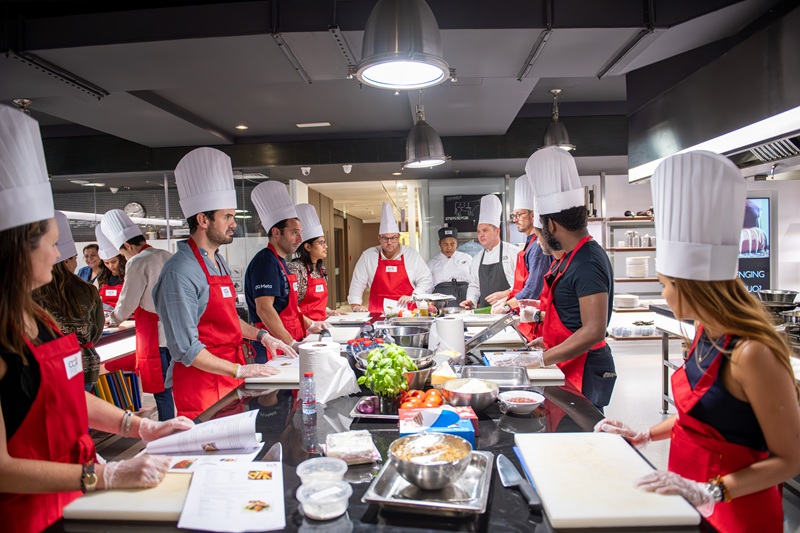
ICCA Dubai’s Corporate Team Building experiences are designed for companies that want a more engaging and hands-on alternative to conventional team workshops.
In a professional kitchen setting, teams collaborate through cooking challenges that require planning, communication, time management, leadership, creativity, and problem-solving. The format works well because the kitchen naturally shows how people behave under pressure. Some participants organise. Some create. Some lead. Some support. The group learns by doing, not by listening passively.
This makes it suitable for annual off-sites, department bonding, executive retreats, client entertainment, new team integration, and employee engagement days. Depending on the brief, the format can be adapted for smaller leadership groups or larger corporate teams.
Corporate Solutions for Hospitality Companies
ICCA’s Corporate Solutions are designed for hospitality and F&B businesses that require more specific operational training.
Hotels, restaurants, catering companies, cafés, cloud kitchens, and F&B operators often need training that connects directly to food quality, service consistency, kitchen productivity, brand standards, and commercial performance. ICCA’s hospitality-focused training can be shaped around practical needs such as kitchen upskilling, recipe consistency, culinary techniques, product application, service workflows, and team capability development.
For wider industry support, ICCA’s Industry Support also reflects its role in supporting hospitality and F&B businesses with training-led solutions.
Brand Activations for F&B Brands
ICCA Dubai’s Brand Activations are suitable for food and beverage brands that want to showcase products through hands-on application.
Instead of presenting ingredients, equipment, or packaged products only through brochures or displays, brands can demonstrate how they work in real recipes, service formats, or menu concepts. This can support product launches, distributor training, trade engagement, chef demonstrations, influencer sessions, and B2B customer education.
For F&B brands entering Dubai or the wider GCC market, this type of activation can help buyers, chefs, distributors, and hospitality partners understand the commercial use of the product more clearly.
CPD Programs for Hospitality Professionals
ICCA’s CPD Programs support working hospitality professionals who want to stay current with techniques, standards, and industry expectations.
Continuous Professional Development is useful because hospitality does not stand still. Food trends, customer expectations, menu styles, technology, sustainability considerations, and operational standards continue to evolve. Short, focused learning formats allow professionals to strengthen specific skills without stepping away from work for long periods.
For employers, CPD can also support retention and team motivation. It gives staff a structured way to keep improving while remaining active in the workplace.
Menu Planning & Recipe Development for F&B Businesses
For restaurants, hotels, cafés, catering companies, and food entrepreneurs, menu decisions directly affect revenue, cost control, brand perception, and guest satisfaction.
ICCA’s Menu Planning & Recipe Development support can help F&B businesses work through recipe standardisation, menu engineering, costing, nutritional considerations, product application, and operational practicality.
A strong menu is not only creative. It must also consider ingredient availability, preparation time, staff capability, kitchen capacity, portion control, waste, margin, and consistency. This makes menu development one of the most commercially relevant areas of corporate training and consulting for F&B businesses.
Other Corporate Training Providers in Dubai
Dubai has a broad corporate training market. The providers below are commonly associated with professional training in the UAE and GCC, but companies should verify current operating status, Dubai presence, course availability, and approval details before booking.
PROTRAINING
PROTRAINING is a corporate training provider associated with leadership, sales, communication, HR, customer service, and workplace performance programs.
Its appeal is usually strongest for companies looking for practical corporate workshops rather than academic-style courses. Programs may be adapted for different departments, including sales teams, managers, customer-facing staff, and internal operations teams.
For companies considering PROTRAINING, the key checks should include current Dubai licensing or KHDA listing, trainer experience, client references, and whether the program is customised or delivered from a standard outline.
Ignite Training
Ignite Training is known in the market for leadership, team building, communication, and experiential learning formats.
Its programs are typically suited to companies that want active participation, group exercises, and behaviour-based learning rather than lecture-heavy delivery. This can be useful for teams that need to improve communication, confidence, collaboration, or leadership presence.
Companies should confirm the exact program structure, delivery language, trainer background, and whether any certificate issued is provider-issued, KHDA-related, or linked to a professional body.
GLOMACS
GLOMACS is a well-known regional name in professional training, with a broad catalogue covering management, leadership, finance, HR, procurement, contracts, engineering, project management, and technical topics.
Its strength is breadth. Larger organisations with multiple departments may find this useful when planning a wide training calendar across different functions.
Because course catalogues and credentials can vary by program, companies should verify the exact course outline, venue, certification pathway, trainer profile, and any KHDA or professional-body recognition attached to the specific course.
Meirc Training
Meirc Training is another established regional provider covering management, leadership, HR, finance, operations, communication, strategy, and other professional development areas.
It is often considered by companies that want structured public courses, in-house training, and broader corporate development programs. Its regional presence makes it relevant for companies operating across the Middle East.
Before booking, companies should check whether the course is open-enrolment or customised, what assessment is included, and whether the certificate is provider-issued or connected to an external professional body.
Oxford Management Centre
Oxford Management Centre is positioned around executive development, leadership, strategy, governance, and senior management training.
Its programs may be suitable for directors, senior managers, department heads, and executives who need more strategic learning formats. Topics can include leadership, organisational performance, governance, risk, communication, and management excellence.
When describing this provider, it is safer to refer to its executive and management positioning rather than making broad claims about official British accreditation unless a specific program confirms it.
Euromatech
Euromatech is commonly associated with technical and professional training areas such as project management, quality, engineering, health and safety, oil and gas, procurement, contracts, and operations.
It may be relevant for companies where technical standards, safety, project control, and process discipline are important. Engineering firms, construction companies, infrastructure operators, and energy-related businesses may find its course mix more relevant than general soft-skills providers.
Companies should confirm the specific relationship between each course and any external certification body, especially where names such as PMI, IOSH, NEBOSH, or similar organisations are referenced.
WingsWay Training
WingsWay Training is associated with aviation, travel, tourism, logistics, and customer-service-related programs.
This type of provider may be relevant for companies connected to airlines, airports, travel agencies, tourism operators, cargo, logistics, or customer-facing transport services. In aviation and travel training, however, certification wording needs particular care.
Companies should verify current IATA-related status, KHDA listing, active course scope, and whether certificates are provider-issued or connected to a recognised industry body.
How to Choose a Corporate Training Provider
Choosing a provider for corporate training in Dubai should be a structured decision. Companies should look beyond the course title and assess approval status, industry fit, trainer credibility, flexibility, measurement, and commercial relevance.
KHDA Approval & Recognition
In Dubai, KHDA is an important reference point for private training institutes. KHDA maintains an education and training directory where training institutes can be searched.
However, companies should avoid assuming that every course from a listed provider carries the same status. Approval may relate to the institute, program, activity, or certificate type. Before booking, HR and L&D teams should ask the provider to clarify exactly what is KHDA-listed, KHDA-permitted, provider-issued, or externally certified.
This distinction matters. KHDA, PMI, IATA, ILM, IOSH, NEBOSH, CIPD, SHRM, City & Guilds, and Worldchefs do not all play the same role. Some are regulators, some are awarding organisations, some are professional bodies, some are membership bodies, and some are certification or examination pathways.
Customisation & Flexibility
The strongest corporate training providers do not simply deliver the same slide deck to every company. They first understand the company’s needs, team structure, industry, service standards, and pain points.
A useful provider should be able to conduct a training needs analysis, adapt examples to the company’s working environment, offer flexible scheduling, and deliver either on-site or at a specialist facility.
This is particularly important in Dubai, where teams may work in shifts, serve international customers, and operate across multiple locations. A hotel, a trading company, a bank, a restaurant group, and a logistics firm may all need communication training, but the scenarios should not be the same.
Industry Expertise
Industry fit is one of the most important selection criteria.
A hospitality company benefits from a provider that understands kitchens, service flow, guest expectations, F&B standards, and operational pressure. A technical firm may need engineering or safety expertise. A financial services company may require regulatory and risk awareness. An aviation company may need sector-specific certification pathways.
For culinary, hospitality, and F&B businesses, ICCA Dubai’s practical training environment gives it a clear advantage because learning can be connected directly to food production, service realities, menu performance, and team execution.
Measurement & ROI
Corporate training should be measured, but it should not be treated as a guaranteed shortcut to higher revenue or retention. Training can support business improvement when it is properly designed, applied, reinforced, and measured.
Companies should set KPIs before training begins. Depending on the program, these may include employee satisfaction, guest feedback, sales conversion, complaint reduction, productivity, staff retention, safety compliance, service consistency, or manager feedback.
Pre- and post-training assessments, participant feedback, manager observation, and follow-up reporting can help companies understand whether the learning is transferring into workplace behaviour.
Budget Considerations
Pricing for corporate training in Dubai varies widely. As an indicative market range, companies may encounter anything from around AED 500 to AED 5,000+ per person per day, depending on the provider, trainer seniority, topic, group size, venue, materials, certification, customisation, and delivery format.
Premium experiential formats, such as culinary team building, may be priced differently from classroom-based soft-skills workshops because ingredients, facilities, equipment, facilitation, and operational setup are part of the experience.
The better question is not only “How much does it cost?” but “What should the team be able to do better afterwards?” Companies reviewing broader options may also find ICCA’s guide to training courses in Dubai useful for comparing skills-based pathways.
Corporate Training Trends in Dubai for 2026
Corporate training in Dubai is becoming more practical, personalised, and outcomes-focused. Companies are moving away from passive classroom formats and looking for learning experiences that connect directly to work performance.
AI-Powered Personalised Learning
AI is beginning to influence how companies design and deliver training. Organisations are using AI tools for skills gap analysis, learning recommendations, adaptive quizzes, coaching support, and personalised learning pathways.
This fits the UAE’s wider direction on AI adoption and future skills. For companies, the practical challenge is to make AI training relevant to daily work. Employees need to understand how to use AI tools responsibly, improve workflows, support decision-making, and protect data.
Experiential & Team-Based Learning
Experiential learning is one of the clearest trends in corporate training in Dubai. Companies want employees to participate, collaborate, and apply skills rather than only listen to a trainer.
Culinary team building, simulation exercises, role plays, business games, and scenario-based workshops are becoming more popular because they reveal behaviour in action. Participants can practise leadership, communication, delegation, timing, and problem-solving in a safe but realistic environment.
This is where ICCA Dubai’s culinary team-building format fits naturally. A professional kitchen creates a live setting where teams must coordinate, decide, execute, and adapt.
Hybrid Training Models
Hybrid training is now common for companies with regional teams, multiple offices, or employees working across different schedules.
A hybrid model may include online pre-work, in-person workshops, virtual coaching, post-session assignments, and follow-up assessments. This can help companies train distributed teams while still using face-to-face sessions for higher-impact activities.
For technical, compliance, and leadership training, hybrid formats can also reduce downtime while allowing learning to continue over a longer period.
Wellness & Soft Skills Focus
Wellness, resilience, stress management, emotional intelligence, and mental health awareness are increasingly included in corporate training plans.
Dubai’s competitive work environment can place pressure on employees, especially in customer-facing sectors. Soft skills are therefore being treated with more seriousness. Communication, empathy, adaptability, and conflict management can directly affect employee wellbeing, customer satisfaction, and team stability.
Choosing Training That Builds Real Capability
The best corporate training in Dubai is not chosen by course title alone. It is chosen by relevance, delivery quality, industry fit, and the ability to improve real workplace capability.
For some companies, the priority may be leadership development. For others, it may be technical upskilling, Emiratisation readiness, customer service, compliance, team communication, or department-level performance. In hospitality and F&B, the most valuable training is often the kind that stays close to the actual work — the kitchen, the service floor, the guest, the menu, the product, and the team.
ICCA Dubai’s corporate offerings are particularly relevant for companies looking for hands-on, hospitality-grounded, and commercially practical learning. Through corporate team building, corporate solutions, brand activations, CPD programs, and menu planning support, ICCA connects training with real industry environments and operational outcomes.
For organisations reviewing their next training cycle, the starting point should be simple: what should the team be able to do better after the program? Once that answer is clear, the right training partner becomes easier to identify.