Nobody becomes a chef overnight. It starts with a curiosity about flavours and the satisfaction of feeding people well. If that sounds like you, and you are in the UAE or thinking of moving here, the timing is right, and the numbers back it up. Tourism contributes roughly 14% of the UAE's GDP — around USD $70 billion in 2025 — with hotel guest volumes climbing nearly 5% year-on-year to 23 million visitors. That's a lot of meals. A lot of menus. And a constant, growing need for skilled chefs to make it all happen. This guide is for anyone who's serious about the culinary path — whether you're a school leaver figuring out your options, someone mid-career finally listening to that voice in the back of your head, or an international chef weighing up a move to the Gulf. We'll walk you through the real route. No fluff, no shortcuts.
Understanding the Chef Profession in UAE

Before we talk about how to become a chef, it helps to understand what a chef actually is. A cook prepares food; a chef owns the food, the team, the standards, and the costs. That difference is what employers hiring a chef in Dubai are really paying for.
A cook prepares food. A chef is responsible for the food, the team, the standards, the costs, and the experience on the plate. That distinction matters everywhere, but in the UAE — where guests arrive from 200+ nationalities with high expectations — it matters enormously.
The professional kitchen runs on a system developed by the legendary French chef Auguste Escoffier: the Kitchen Brigade. It's a hierarchy that's as relevant in Dubai's five-star hotels today as it was in 19th-century Paris:
What makes the UAE's culinary scene particularly exciting is the sheer diversity of what's on the table. Dubai and Abu Dhabi experienced a notable increase in Michelin-starred restaurants in 2024, reinforcing the UAE's status as a global culinary hub that attracts world-class chefs. Indeed From Japanese omakase to Emirati heritage dining, modern European to South Asian street food — a chef in Dubai needs range, adaptability, and genuine curiosity about world cuisines.
How to Become a Chef in Dubai: The Step-by-Step Path
Becoming a chef in Dubai follows a clear route: train, certify, get kitchen experience, then climb the brigade. The steps below summarise the full guide that follows, so you can see the whole path at a glance before reading the detail.
The 5 Steps to Becoming a Chef in the UAE
You become a chef in Dubai in five steps. First, complete a recognised culinary diploma, ideally one with City and Guilds accreditation and KHDA attestation. Second, secure your food handler's card from Dubai Municipality, a standard employment requirement. Third, gain 1 to 3 years of hands-on kitchen experience, starting at commis level in a hotel or fine dining kitchen. Fourth, build technical and soft skills, knife work, classical methods, stress management, and food safety, that move you from commis to chef de partie. Fifth, progress through the brigade toward sous and head chef as your reputation and results grow. A structured program with guaranteed placement, such as ICCA Dubai's Level 2 Diploma, compresses the early stages of this path.
Educational Pathways and Culinary Training

This is the question most aspiring chefs wrestle with: Do I really need culinary school?
The short answer is: not technically. The longer answer is: in the UAE, formal culinary education gives you a significant head start — in job readiness, salary negotiation, and credibility with top employers.
What to look for in a UAE culinary program:
- City & Guilds, London accreditation — the gold standard for vocational culinary qualifications, widely recognised by employers across the UAE and internationally
- KHDA attestation — Knowledge and Human Development Authority attestation from the Government of Dubai is required for local employment recognition
- WorldChefs recognition — the global benchmark for culinary skills, used by employers worldwide to verify candidate quality
- Hands-on training — time in a real kitchen, not just a classroom
ICCA Dubai's Level 2 Diploma in Food Preparation and Culinary Arts (Cookery) is one of the most respected programs in the region and ticks all of these boxes. This application-focused, industry-centred program is accredited by City & Guilds, London, and carries WorldChefs recognition for quality culinary education.
The program is available as a full-time intensive 3-month course (4 days per week, 07:00 AM to 05:30 PM) or as a part-time weekend program taking approximately 12 months to complete. Both lead to the same internationally recognised qualification.
Upon completion, graduates receive a City & Guilds IVQ Level 2 Diploma in Food Preparation and Culinary Arts, KHDA-attested attendance, and the WorldChefs Global Culinary Certification at Commis Chef level.
Essential Skills and Qualifications Required
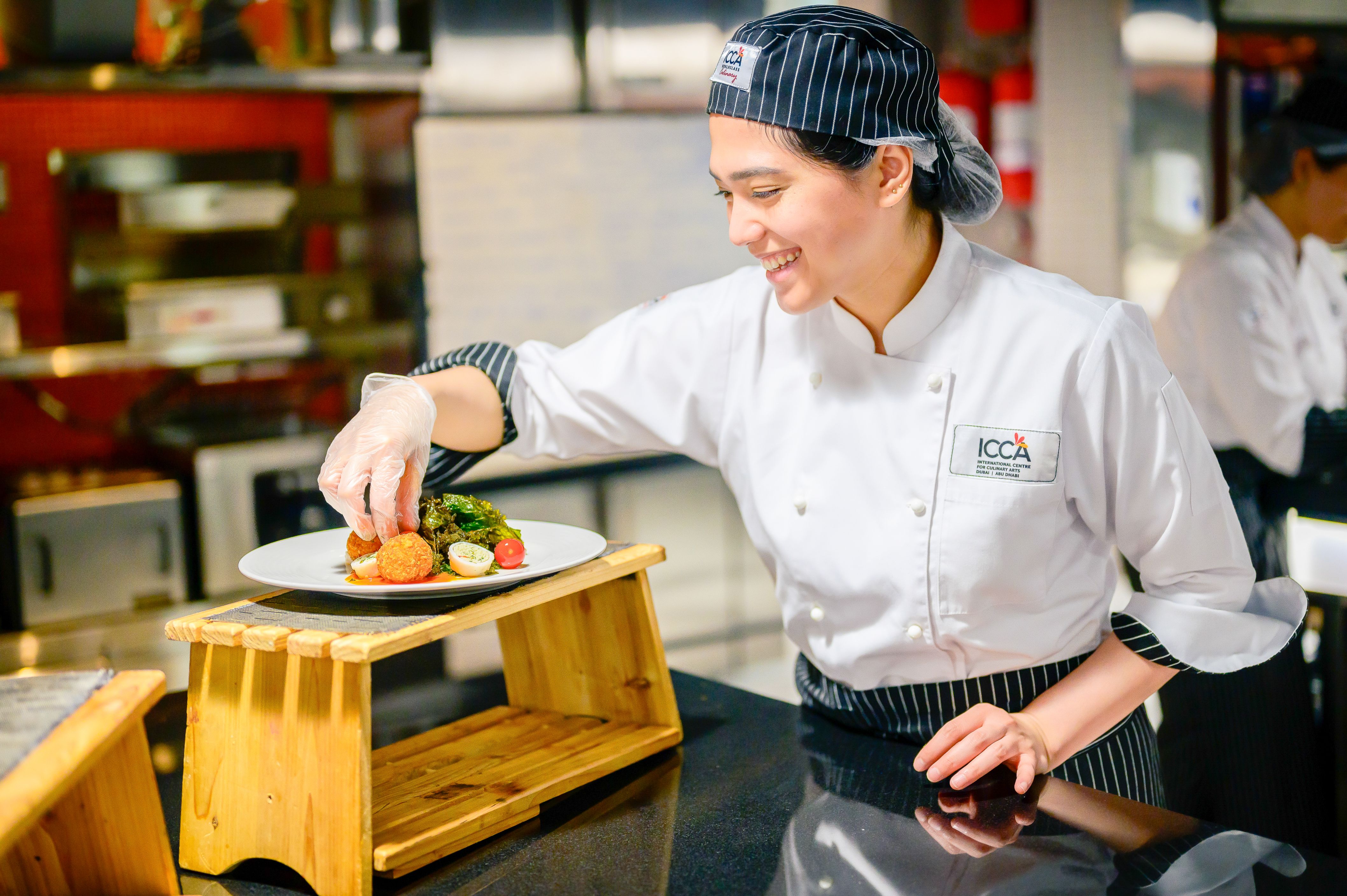
The right qualification gets you in the door. What happens inside the kitchen is determined by your skills — and in the UAE, the bar is high.
Technical skills every aspiring chef needs:
- Knife skills — precision, speed, and consistency are non-negotiable in a professional kitchen
- Classical cooking methods — roasting, braising, sautéing, poaching, grilling, steaming
- Stocks, sauces and soups — the foundation of classical continental cuisine
- Understanding of ingredients — quality points, cuts, purchase specifications, and sustainability
ICCA Dubai's Cookery Diploma covers this comprehensively, moving from stocks, sauces, and soups through salads and appetisers, to poultry, meat, seafood, and an introduction to baking and pâtisserie — all with a focus on classical continental techniques applied in a modern context.
Soft skills that separate good chefs from great ones:
- Stress management — service is fast, high-pressure, and unforgiving. The ability to stay calm and focused under pressure is what keeps a kitchen running
- Team communication — you will spend your career working in close quarters with people from different cultures and backgrounds
- Time management — in a kitchen, timing is everything. Literally
- Leadership — even early in your career, you need to understand how to take direction and how to give it
Food safety and hygiene:
Dubai Municipality enforces strict food safety standards. Every chef working in the UAE must understand HACCP principles, food handling requirements, and hygiene compliance. A food handler's card from Dubai Municipality is a standard employment requirement, and it's something reputable culinary programs prepare you for from day one.
Gaining Practical Experience in UAE Kitchens

There is no shortcut to kitchen experience. You can read every culinary textbook ever written, and none of it prepares you for the noise, speed, and energy of a real service. You need to be in it.
The UAE's culinary scene offers extraordinary opportunities for early-career chefs — if you're strategic about where you start.
Where to seek your early experience:
- Five-star hotels: properties like Atlantis The Palm, Burj Al Arab, Four Seasons, and Jumeirah Group expose you to high standards, diverse menus, and structured brigade kitchens from day one
- Fine dining restaurants: Dubai's growing Michelin-starred and recommended scene gives you proximity to serious craft
- International hotel brands: Marriott, Accor, Hilton, and IHG all operate major UAE properties with large kitchen teams and structured training programs
The general expectation in the UAE market is 1–3 years of hands-on kitchen experience before a chef designation is truly earned. At the Commis level, you're absorbing, watching, and building muscle memory. By the Chef de Partie stage, you're running a section. The difference in skill — and salary — is significant.
ICCA Dubai's Industry Work Experience Placement (IWEP) program bridges this gap directly, offering students guaranteed internship and job placement with leading UAE hospitality brands upon graduation, ahead of their peers by over two years.
Timeline and Career Progression
One of the most common questions from aspiring chefs is: How long does it actually take?
Here's an honest timeline:
Exceptional talent can move faster — particularly in the UAE, where strong growth in the hospitality sector means skilled chefs are promoted ahead of schedule. The UAE's fine dining scene saw a surge in exclusive dining experiences in 2024, including chef's table events and immersive dining concepts, creating new openings for talented culinary professionals at every level.
UAE-specific career factors to be aware of:
- Your employment visa is sponsored by your employer, which means changing jobs requires coordination and sometimes a cooling-off period
- Most luxury hotel contracts are 2-year rolling agreements with annual performance reviews
- Building a reputation within one brand (e.g. across multiple Jumeirah properties) can accelerate progression faster than job-hopping
Cost Considerations and Investment
Culinary education is an investment — and in the UAE, it's one with a clear and measurable return.
ICCA Dubai's Level 2 Diploma in Food Preparation and Culinary Arts (Cookery) is priced at AED 47,448 total for UAE residents (inclusive of tuition, City & Guilds registration, KHDA attestation, textbooks, and uniform), or approximately USD 13,182 for international students.
For those looking for a broader qualification, ICCA's Chef's Essentials Package — combining both the Cookery and Baking & Patisserie Diplomas — is available at AED 80,512 after discount (saving AED 14,384 off the standard price).
Is it worth it?
A Commis Chef in Dubai earns AED 2,500–3,500/month. A Chef de Partie earns AED 5,000–8,000. An Executive Chef in a luxury property earns AED 15,000–25,000+. All tax-free.
At mid-level, a trained chef with a recognised qualification can recoup their tuition investment within 12–18 months of employment. Over a career, the gap between a formally trained chef and one without qualifications — in terms of salary ceiling, promotion speed, and international mobility — is substantial.
UAE residents can also pay in installments secured by post-dated cheques, making the program accessible without requiring the full amount upfront.
Culinary Qualifications Recognised in the UAE
Qualifications open doors. Here's what matters most in the UAE market:
Essential credentials:
- City & Guilds IVQ Diploma — internationally recognised vocational qualification, the industry standard across UAE luxury hospitality
- KHDA attestation — mandatory for formal employment recognition by UAE authorities
- WorldChefs Certification — the only globally standardised chef certification, increasingly requested by international hotel groups
- Food handler's card — issued through Dubai Municipality-approved training; required for anyone working with food in Dubai
- HACCP knowledge — not a separate card, but demonstrated understanding is tested during municipality inspections and hotel compliance audits
For senior roles, the American Culinary Federation (ACF) Certified Executive Chef credential is recognised and respected in international properties, though it requires significant documented experience on top of formal education.
Networking and Career Opportunities
In the UAE's culinary world, who you know matters — but what you can do matters more. The two work together.
Events worth attending:
- Gulfood (Dubai World Trade Centre, February annually) — one of the world's largest food and hospitality exhibitions, attracting tens of thousands of F&B professionals, buyers, and chefs
- Emirates Culinary Guild competitions — representing your establishment in culinary competitions builds your profile, your confidence, and your CV
- Hotel career days — major hotel groups hold open recruitment events; following their HR pages on LinkedIn gives you early notice
Professional associations:
Joining the Emirates Culinary Guild connects you to a community of chefs across the region, provides access to competitions and CPD events, and signals to employers that you take your profession seriously.
ICCA Dubai's IWEP program provides direct placement connections with top UAE hospitality brands, giving graduates a built-in professional network before they've even completed their first contract.
Alternative Routes and Specialisations
The chef career path in the UAE isn't linear — and it doesn't have to be.
Specialisation routes:
- Pastry Chef: one of the most in-demand specialisations in UAE luxury hospitality, with Executive Pastry Chefs earning AED 15,000–25,000+ at flagship properties
- Private Chef: high-net-worth individuals, royal households, and corporate executives across the UAE employ personal chefs, often at premium rates with exceptional lifestyle packages
- Corporate catering: government entities, airlines, and large corporations employ culinary teams at scale — less glamorous than hotel kitchens, but often more structured hours and better stability
Entrepreneurship:
Dubai's thriving food startup scene saw a surge in chef-led dining concepts in 2024 Indeed, from cloud kitchens and specialty cafés to pop-up supper clubs and food truck concepts. Dubai's regulatory environment has become increasingly entrepreneur-friendly, with home-based kitchen licenses, cloud kitchen permits, and simplified trade licensing making it easier than ever to launch a food business.
ICCA Dubai's Restaurateur's Package — combining both professional diplomas with the Level 3 Advanced Diploma in Culinary Arts and Supervision — is specifically designed for entrepreneurs and professionals looking to set up a food business or elevate their kitchen operations, available at AED 117,840 after discount.
Media and content:
Dubai's food media scene is growing rapidly. Chef-led YouTube channels, Instagram accounts, and food consultancy roles are increasingly viable career streams — particularly for chefs who combine strong technical skills with genuine communication ability.
Ready to Take the First Step?
The UAE's culinary industry is expanding at a pace that genuinely rewards those who arrive prepared. The right training, the right certification, and the right placement can compress years of trial-and-error into a clear, structured launch.
ICCA Dubai's Level 2 Diploma in Food Preparation and Culinary Arts (Cookery) gives you internationally accredited qualifications, hands-on training in a world-class facility, and guaranteed work placement with leading UAE hospitality brands — all within 90 days of intensive training.
Upcoming intakes: April 13, May 18, July 13, August 17, October 12, and November 16, 2026.
👉 Apply Now for the Professional Diploma in Culinary Arts at ICCA Dubai
Frequently Asked Questions
Q: How do you become a chef in Dubai?
A: You become a chef in Dubai by completing a recognised culinary diploma (City and Guilds accredited and KHDA attested), getting a Dubai Municipality food handler's card, and building 1 to 3 years of kitchen experience from commis level upward. A program with guaranteed work placement shortens the route.
Q: What culinary qualifications are recognised in the UAE?
A: UAE employers recognise City and Guilds IVQ diplomas, KHDA-attested qualifications, and WorldChefs certification, plus a Dubai Municipality food handler's card for anyone working with food. For senior roles, the American Culinary Federation Certified Executive Chef credential is also respected.


.jpg)